Last updated November 18, 2026
ADU Permits, Codes & Inspections in NV: What You Need to Know
Nevada SB 180 made accessory dwelling units legal across the state, and a lot of homeowners read that headline and assumed the hard part was over. Here’s the part the headline left out: state law sets a floor, not a ceiling. Each jurisdiction layers its own zoning, utility, and design rules on top, and a project that sails through in Henderson can get rejected in Mesquite for reasons that never show up in a state-level summary. This guide walks through the actual regulatory stack a Mesquite homeowner is working inside: what the state requires, what the city still controls, which permits you’ll need, and why a finished ADU without a certificate of occupancy can turn into a title problem at resale.
Quick Answer
In Nevada, an ADU is legal statewide under SB 180, but it still needs local zoning approval, a full building permit package (building, electrical, mechanical, plumbing), and a certificate of occupancy before you can legally use it. In Mesquite, the city’s zoning code, HOA covenants in master-planned communities, and utility capacity can each stop a project that passed the state-law test. Budget the permit process separately from construction and expect it to take several weeks to a few months depending on how complete your first submission is.
Table of Contents
- What Nevada State Law Requires vs. What Mesquite Still Controls
- The Permit Types a Mesquite ADU Needs
- How HOA Rules in Mesquite Interact With State ADU Law
- Why Mesquite ADU Permits Get Rejected on First Submission
- What Inspections Actually Look Like
- What a Certificate of Occupancy Requires
- Why an Unpermitted ADU Becomes a Resale Problem
- What ADU Permitting and Building Costs in Mesquite
What Nevada State Law Requires vs. What Mesquite Still Controls
SB 180 was written to remove the blanket local bans that kept homeowners from adding a second unit. It requires jurisdictions to allow ADUs in single-family zones, limits how far cities can push parking requirements, and restricts some of the discretionary review that used to kill projects quietly. What it does not do is hand you an approval. The state set the floor; the city still gets to decide how your specific lot meets it.
Here’s roughly where the line falls:
- The state protects your right to build one: ADUs are permitted in single-family zones, owner-occupancy rules are constrained, and cities can’t require more parking than the statute allows.
- Mesquite controls the site plan: setbacks, lot coverage, height limits, and where the unit sits relative to the main house are all municipal calls.
- Mesquite controls the design standards: exterior materials, roof pitch matching, entry orientation, and window placement can all be reviewed against the city’s development code.
- The utility has a say too: water and sewer capacity review is separate from zoning, and a lot that’s technically zoned for an ADU can still fail a capacity check.
What this means practically: don’t buy a prefab unit or sign a construction contract until you’ve confirmed your specific parcel clears the Mesquite zoning review. The state-law test is the easy part. The lot is where projects live or die. If you’re still deciding between a detached unit, an attached addition, or a garage build, our ADU Builders in Mesquite page covers the build types in more detail.
The Permit Types a Mesquite ADU Needs
A Mesquite ADU is not one permit. It’s a package, and each piece of the package triggers its own review and its own inspections. Miss one and you’ll either get stopped mid-build or end up with a unit that can’t be legally occupied.
Here’s the permit stack you should expect:
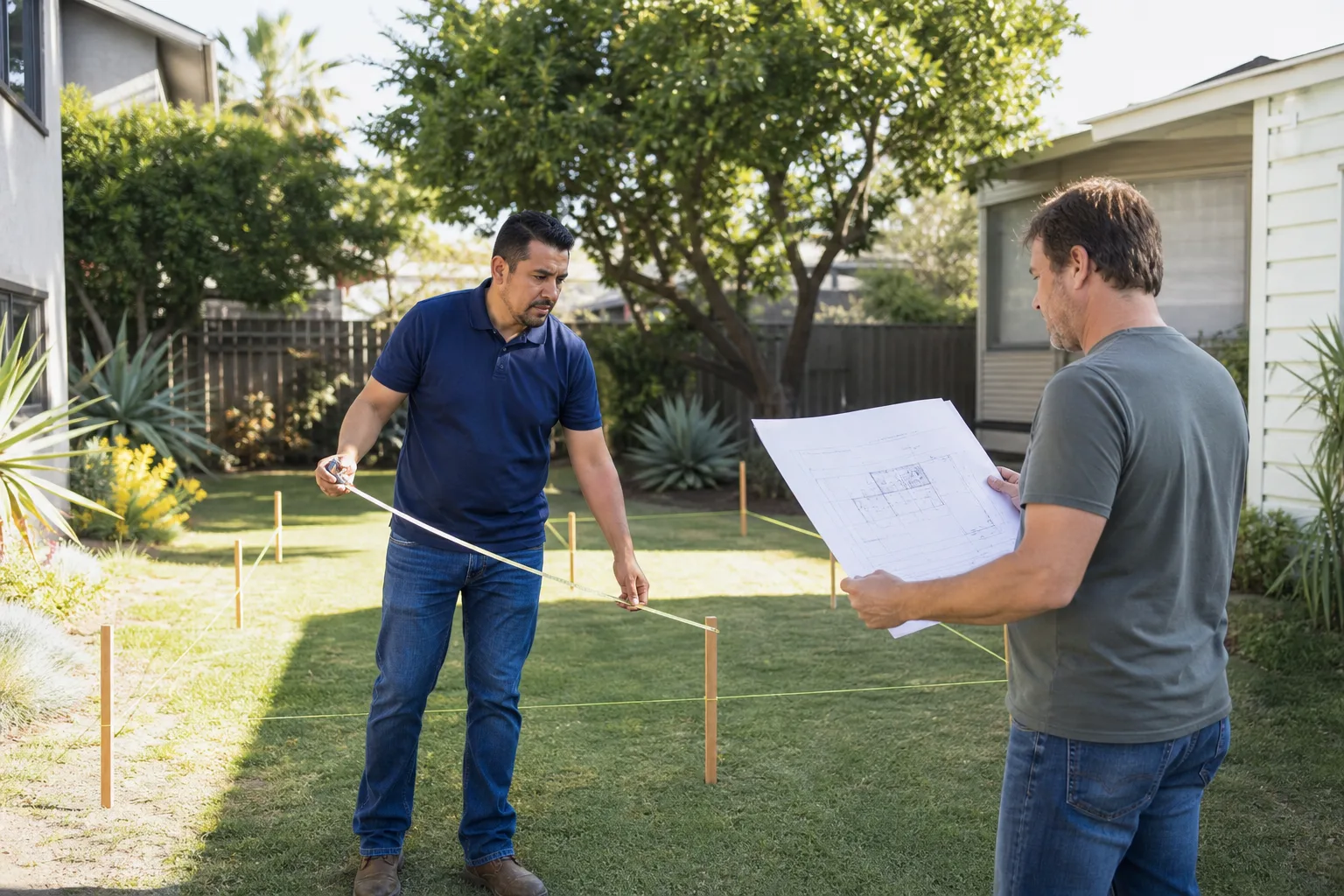
- Zoning or site plan approval. This comes first. It confirms your lot, setbacks, and unit placement comply with the development code before anyone draws construction documents.
- Building permit. The structural permit covering foundations, framing, sheathing, and the envelope. For a prefab or modular unit from a platform like Cover, Dvele, or Boxabl, you’ll still need a local building permit even though the factory handles some of the work.
- Electrical permit. Separate trade permit. Panel capacity is the usual sticking point, especially if you’re adding a full kitchen and a heat pump to a garage conversion.
- Mechanical permit. Covers HVAC equipment, ducting, and ventilation. Mesquite’s summer heat means the mechanical review gets real scrutiny on load calculations.
- Plumbing permit. Water supply, drain lines, and sewer connection. If your lot needs a new sewer tap, that’s a separate utility approval on top of the plumbing permit.
- Grading and drainage review. Mesquite’s flash-flood exposure means site drainage gets reviewed, not waved through. A unit that pushes runoff onto a neighbor’s lot will get flagged.
If you’re converting an existing garage rather than building new, the permit set is narrower but not absent: you’re still pulling a building permit for the habitable-space conversion, plus the trades. Our Garage Conversion Contractor in Mesquite page breaks down what changes when you’re working inside existing walls.
How HOA Rules in Mesquite Interact With State ADU Law
This is the question that trips up more Mesquite homeowners than any other: what happens when the state says you can build and your HOA says you can’t? The short answer is that state ADU law constrains municipal zoning, not private covenants. If you bought into one of Mesquite’s master-planned communities, your CC&Rs are a contract you signed, and the HOA board can enforce it independently of what the city allows.
How the two interact in practice:
- The city issues the permit; the HOA issues the approval. You need both. A building permit does not override a recorded covenant restriction.
- Some Mesquite HOAs prohibit second units outright. Read the CC&Rs before you read the zoning code. If the covenant bars detached units, the state statute doesn’t rescue you.
- Some HOAs allow ADUs but control the look. Design review committees can dictate materials, colors, rooflines, and landscaping screening. This is where James Hardie siding color choices become a committee decision.
- Rental restrictions are common. Even where ADUs are permitted, some covenants limit short-term rentals or require owner-occupancy on the main house.
The order of operations matters. Pull your CC&Rs and any recorded amendments, get the architectural review requirements in writing from the HOA, then take the zoning question to the city. Doing it in the other order wastes months. If the HOA rules are the blocker, the conversation is with the board, not the building department.
Why Mesquite ADU Permits Get Rejected on First Submission
Most first submissions don’t get approved, and it’s usually not because the project is wrong. It’s because the package is incomplete. The building department reviews what’s in front of it, and an incomplete package gets kicked back with comments and a new review clock. In our experience, the same handful of issues account for most of the first-pass rejections in Mesquite:
- Setback encroachment. The unit or its roof overhang lands inside the required side or rear setback. Overhangs count in some reviews and don’t in others; the answer lives in the development code, not in the plan set.
- Lot coverage over the limit. An ADU plus the main house, driveway, and patio can push the site past the allowable impervious coverage. This one surprises people because the house was already there.
- No utility capacity documentation. Missing water or sewer capacity confirmation stalls the package before it reaches plan review.
- Incomplete structural calcs for prefab units. A factory-engineered unit still needs site-specific foundation design and a stamped connection detail for the local wind and seismic conditions.
- Drainage plan missing. Mesquite’s stormwater exposure means a grading and drainage plan is expected, not optional.
- HOA approval not attached. Where covenants apply, reviewers want to see the HOA sign-off in the file.
The fix is boring and it works: submit a complete package on the first pass. That means a site survey with setbacks drawn to scale, a drainage plan, stamped structural details, utility capacity confirmation, and the HOA approval if one applies. A complete package gets through plan review in weeks, not months.
What Inspections Actually Look Like
Inspections are not a single event at the end. They’re a sequence of hold points, and each trade has its own. Missing a hold point means opening up finished work later, which is the most expensive kind of rework.
Here’s the typical inspection sequence for a Mesquite ADU:
- Foundation inspection. After the forms and rebar are set and before the concrete goes in. Nothing gets poured until this passes.
- Underground plumbing and electrical. Before the slab pour. Drain lines and any in-slab conduit get signed off at this stage.
- Framing inspection. After framing and sheathing, before insulation and drywall. This is where the inspector checks structural connections, shear nailing, and the rough-in for windows and doors.
- Rough trade inspections. Electrical, mechanical, and plumbing rough-in all get inspected separately before the walls close up.
- Insulation inspection. After insulation, before drywall.
- Drywall and final trade inspections. Electrical, mechanical, and plumbing finals happen after fixtures and equipment are set.
- Final building inspection. The last hold point. This is what allows the certificate of occupancy to be issued.
For a modular or prefab unit like a Cover or Dvele build, the factory handles some inspections at the plant and the city handles the site work. The handoff has to be documented cleanly, and that’s where prefab projects get slowed down if nobody’s tracking the paperwork.
What a Certificate of Occupancy Requires
The certificate of occupancy (CO) is the document that says the unit is legally habitable. Without it, the unit is a structure, not a dwelling. Getting the CO requires clearing every inspection in the sequence above, plus a final site inspection confirming that what got built matches what got approved.
The CO is where a lot of good builds get stuck for small reasons:
- Final inspections on every trade must pass. One unsigned final holds the whole CO.
- The site has to match the approved plan. That means the setbacks, the grading, and the exterior materials as drawn. Any field change made without a revision gets caught here.
- Addressing and utility connections must be confirmed. The unit needs its own address and its own utility meters where the code requires them.
- Life-safety items need to be in place. Smoke and carbon monoxide alarms, egress windows in the sleeping areas, and safe stairway and landing details.
A Mesquite ADU without a CO can’t be legally rented, can’t be counted as living space on a listing, and can trigger an insurance problem the first time a claim is filed. The CO is not paperwork. It’s the thing that makes the unit real.
Why an Unpermitted ADU Becomes a Resale Problem
An unpermitted ADU sits on the property as a liability, not an asset. It’s a structure the city has no record of, which means the title company won’t count it, the appraiser won’t value it as living space, and the buyer’s lender won’t finance against it. Some insurers exclude structures that were never permitted, and a claim on a fire or water loss in an unpermitted unit can become a coverage dispute.
The problem often surfaces at the worst possible moment. A buyer’s inspector finds a finished unit with no permit history, and the deal either falls apart or the seller is asked to pay for retroactive permitting and inspection at the eleventh hour. In Mesquite, retroactive permitting on an already-built unit means opening walls for inspection, and sometimes it means tearing work out to bring it into compliance. The original savings vanish.
This is the reason we submit a complete package and follow it through inspection instead of shortcutting the process. A permitted ADU adds assessed value and appraisable square footage. An unpermitted one subtracts from the sale. Every time.
What ADU Permitting and Building Costs in Mesquite
Homeowners ask about the total number, but the honest answer is two numbers: the permit and fee cost, and the construction cost. Here are the ranges we see in the Mesquite market. These are estimates, not quotes; the actual number depends on the lot, the unit type, and how much site work is involved.
- Permit and plan review fees: roughly $2,500 to $6,000 for a typical detached ADU, with plan review and impact fees on top depending on the unit’s square footage.
- Garage conversion (existing structure): typically $45,000 to $85,000 before permit fees, depending on whether the slab, framing, and utilities can be reused.
- Detached stick-built ADU: commonly $150,000 to $250,000 for a one-bedroom unit including site work, utilities, and finishes.
- Prefab or modular ADU (Cover, Dvele, Boxabl): the unit itself runs $90,000 to $200,000, plus site work, foundation, utility connections, and permit fees.
Mesquite’s climate adds a real line item that most national cost guides leave out: cooling load. A well-insulated, correctly specified mechanical system matters more here than in places with mild summers, and undersizing the HVAC to save money on the front end costs more over the life of the unit. Every project we build gets a written price before any work starts, with the construction cost and the permit cost separated, so the number you approve on day one is the number on the final invoice. For a fuller budget picture, our Room Addition Contractor in Mesquite page covers the room-addition side.
Common Mistakes to Avoid
- Assuming the state statute is the whole answer. SB 180 protects your right to build an ADU, but it doesn’t approve your lot. Confirm the Mesquite zoning review and utility capacity before you buy a prefab unit.
- Reading the zoning code before the CC&Rs. In Mesquite’s master-planned communities, the HOA covenant is the binding restriction, and it can prohibit a unit the city would happily approve.
- Submitting an incomplete package on purpose. A partial submission gets returned with comments and restarts the review clock. A complete package is faster, not slower.
- Skipping the drainage plan. Mesquite’s flash-flood exposure means grading and drainage are reviewed. Skipping it gets the whole package rejected.
- Starting construction without a permit. The money saved at the front end shows up as a title and insurance problem at resale, plus a retroactive permitting bill.
- Forgetting the certificate of occupancy. A finished unit without a CO can’t be legally occupied, rented, or counted as living space.
- Not tracking the prefab inspection handoff. Factory inspections and site inspections are separate. If nobody documents the handoff, the CO gets stuck.
When to Call a Professional
If your ADU involves a large build, a garage conversion with structural changes, or a prefab unit, the permit and inspection process is a lot to manage alone. It’s also where projects get stuck. We’ve walked plenty of homeowners through a Mesquite submission that stalled on setback calculations, drainage, or the prefab inspection handoff, and getting it right the first time saves weeks. The Garrison Standard is how we work: show up in the window, price in writing, build by the book, leave the site clean, and stand behind the work for a year. Every project we build comes with a written price before any work starts and the 365-Day Done Right Promise behind it: if something we build fails within a year, we come back and make it right at no charge. Our technicians have up to 20 years of experience, every crew member is background-checked and uniformed, and a live person answers the phone around the clock. Fielding ADU Builders Mesquite offers free estimates on ADU and addition projects. Call (833) 717-0766 to schedule yours.
Frequently Asked Questions

Yes. A Mesquite ADU requires zoning or site plan approval plus a building permit and separate electrical, mechanical, and plumbing trade permits, followed by a certificate of occupancy. SB 180 makes ADUs legal statewide, but it does not waive the local permit process. Call (833) 717-0766 to talk through your project and get a free estimate.
Yes, in many cases. State ADU law constrains municipal zoning, not private covenants. If your recorded CC&Rs prohibit second units, the HOA board can enforce that restriction independently of what the city allows. Read your covenants before you read the zoning code, and get the HOA’s architectural review requirements in writing.
Plan review typically runs several weeks for a complete package. Add time for zoning approval, utility capacity review, and any HOA architectural review. An incomplete submission restarts the clock, which is why most delays come from missing documents rather than from the project itself.
The unit can’t be legally occupied or rented, it won’t count as living space on a listing, and it can create title and insurance problems when you sell. A buyer’s lender may refuse to finance against an unpermitted structure. Retroactive permitting later means opening walls for inspection and often tearing out work that was never approved.
Yes. Factory-engineered units still need a local building permit, site-specific foundation design, utility connections, and a certificate of occupancy. The factory handles some of the inspections at the plant; the city handles the site work. Tracking the handoff between the two is where prefab projects get slowed down.
A garage conversion typically runs $45,000 to $85,000 before permit fees, while a detached stick-built ADU commonly runs $150,000 to $250,000 depending on size, site work, and finishes. Permit and plan review fees typically add $2,500 to $6,000. Call (833) 717-0766 for a written, line-item estimate on your specific lot.
The Bottom Line
Nevada’s state law opened the door, but Mesquite’s zoning code, HOA covenants, and utility capacity decide whether your project walks through it. Submit a complete permit package on the first pass, expect the building, electrical, mechanical, and plumbing permits as a set, and treat the certificate of occupancy as the finish line rather than an afterthought. An unpermitted ADU costs you at resale; a permitted one adds real, appraisable value. Get your setbacks, drainage plan, and HOA approval in hand before construction starts, and the process moves on schedule. The Garrison Standard is how we approach every project in Mesquite: price in writing, by the book, and backed for a full year. If you’re ready to price your ADU, our Mesquite home page is the place to start.
Call Fielding ADU Builders Mesquite at (833) 717-0766 for a free estimate. We’ll review your lot, walk you through the permits your project needs, and put the construction price in writing before any work starts. Whether you’re converting a garage, adding a room, or setting a prefab unit like a Cover or Dvele build in the backyard, the process starts with one call. A live person answers every call, 24 hours a day. Fielding ADU Builders is an independently owned and operated member of the Garrison Partners family, and Garrison Partners has been building to The Garrison Standard since 2006.
Written by the team at Fielding ADU Builders Mesquite.